
Ski Machines Explained
How ski machines work and who they suit
A ski machine uses two handles pulled down against resistance to imitate part of cross-country skiing. It can involve the core, arms and legs together.
What is a ski machine and how does it work?
A standing ski ergometer has cords and handles connected to a resistance mechanism, commonly a fan flywheel. You start tall with hands raised, hinge through the hips and drive the handles down towards the thighs.
The movement is often called double poling, although some machines support alternating arm pulls too. You do not need skis or a track, but you do need room to move your arms and body freely around the machine.
Some ski machines can also be used from a seated position with appropriate setup. Seated technique involves less lower-body work than a standing double-pole stroke, so the muscle emphasis changes.
💡 Tip: Start with shorter controlled pulls and get the hip hinge right. Pulling with straight, tense arms is not the same as using the body efficiently.
Health and safety information: This guide gives general fitness information, not a diagnosis, treatment plan or personal medical advice. A comparison rating cannot tell you whether a machine is safe for your specific health, disability or recovery needs.
If you have a recent injury or operation, persistent pain, a condition affecting exercise or difficulty getting on and off the machine, speak to your GP, physiotherapist or another qualified healthcare professional before starting. Follow the manufacturer’s instructions, use a manageable effort and stop if you feel pain, dizziness, chest discomfort or unusual breathlessness. Seek urgent medical help for serious symptoms.
Benefits of a ski machine
Ski machines suit people looking for an upright pulling movement that brings the upper body into cardio training more directly than a treadmill or conventional bike.
Why people use this machine
- Upper-body involvement: The lats, arms and shoulders help accelerate the handles and resistance flywheel.
- Core and hip contribution: A controlled crunch and hip hinge generate much of the pulling movement.
- Intervals or steady rhythm: You can pull harder for bursts or use a repeatable pace over a longer period.
- Relatively compact installation: A wall-mounted version uses little floor space, though clearance is required for movement.
A ski ergometer is not a full skiing simulator. It concentrates on the double-poling action, so it is best understood as resisted upper-body and core exercise rather than a way to practise every skiing skill.
Start with your core and hips: The powerful part of double poling is not simply bending your elbows. A controlled crunch and hip hinge begin the stroke, with the arms following through. Repeatedly yanking with straight arms can make the movement awkward and overly demanding for the shoulders.
Further evidence: A small laboratory study of trained cross-country skiers using a ski ergometer found substantial contributions from the core and lower limbs during double poling. This supports describing the movement as more than an arm-only pull, but it does not test every home ski machine. Read the ski-ergometer biomechanics study.
Another useful source: A study comparing double poling on skis with a ski-ergometer workout found differences in upper-body muscle activation timing. The machine can reproduce a resisted pulling action without perfectly matching on-snow skiing technique. Read the muscle-activity comparison.
Which muscles does a ski machine work?
A ski machine mainly uses repeated downward pulls through the arms and upper body, helped by the core and hips. The legs help you flex and extend during standing double-poling. Different technique and seated adaptations change which muscles do the most work.
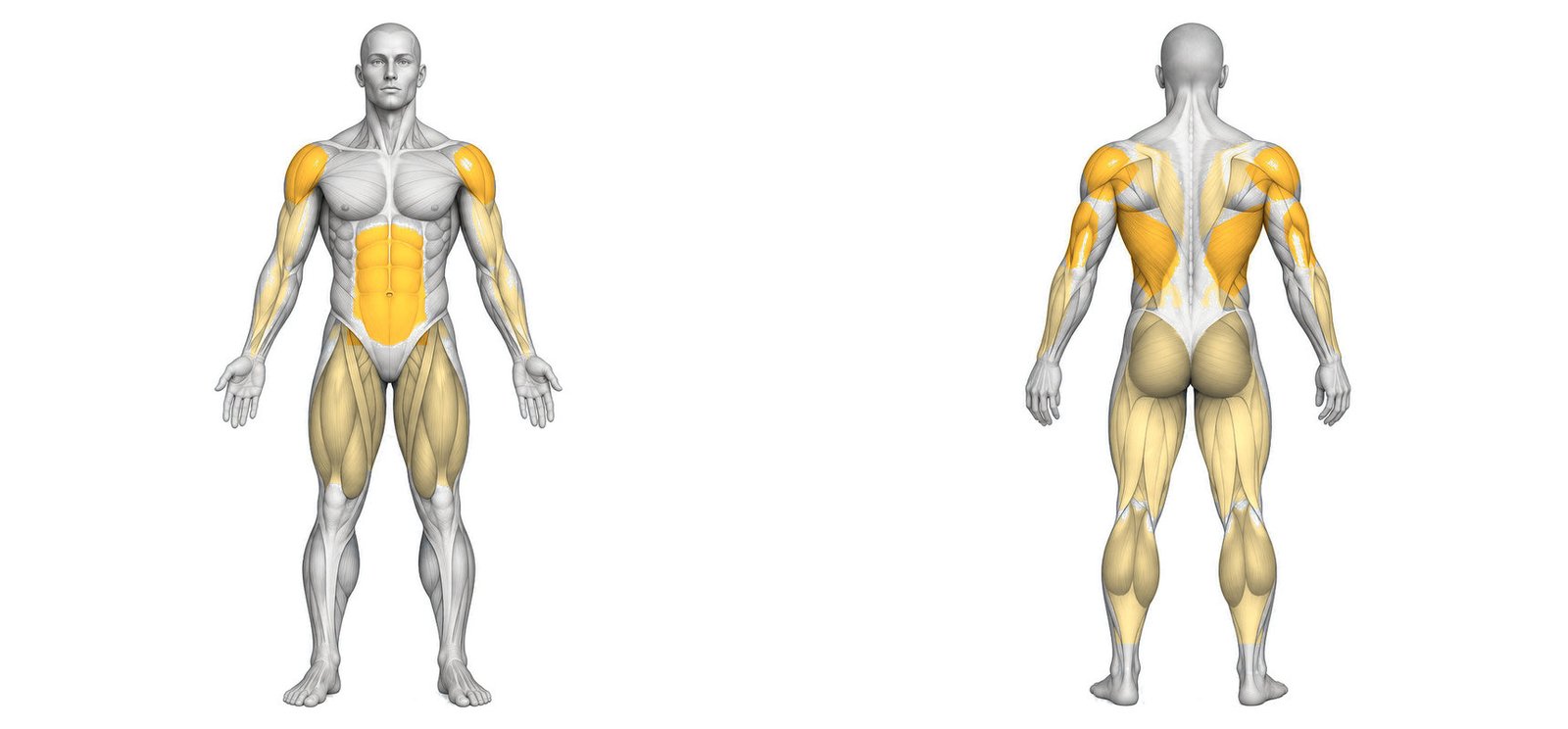
- lats and upper back: Help pull the handles down during each poling stroke.
- Shoulders and triceps: Help drive the arms through the pull and control the return.
- Abdominal and core muscles: Help flex and brace the body during the downward movement.
- Glutes and quads: Assist when the hips and knees bend and extend in standing technique.
- Hamstrings and calves: Help control the lower-body movement and maintain balance.
What the research says: An electromyography study of on-snow double poling found that core and leg muscle involvement increased with speed, while measured upper-limb activity changed less. Because this was skiing rather than an indoor-machine trial, the muscle diagram is a general illustration, not a precise measurement of activation. Read the double-poling muscle-activity study.
Can a ski machine improve fitness and help manage weight?
A ski machine lets you perform steady double-poling or harder intervals. The pulling movement uses the upper body and core with help from the legs when you use a standing technique.
Workload depends on your stroke and resistance setting. Fast pulling isn't always effective pulling – coordinated movement is more useful than treating the handles as a speed contest.
Is a ski machine low impact and easy to use?
There are no running-style landings during double poling, so the movement is lower impact in that sense. However, the shoulders, back, hips and knees can all be under substantial effort.
The standard standing version needs balance and coordination. Seated adaptations are possible on some machines, but a typical standing rating does not cover every rehabilitation need.
Who is a ski machine suitable for?
It helps to look beyond whether a machine is described as suitable for beginners or low impact. Consider the movement it asks you to make, whether you can get on and off comfortably and how your body responds.
Who it can suit
- People wanting active upper-body cardio: The handles require a meaningful pull rather than passive hand support.
- Home users with suitable wall space: Wall-mounted designs can have a compact base.
- Those who enjoy technique-based intervals: A coordinated powerful pull suits brief harder efforts.
Who may prefer a different machine
- People with shoulder or back discomfort: Repeated upper-body pulling and hip hinging may aggravate symptoms.
- Anyone with poor standing balance: The standard standing action needs coordination; seated variants need a suitable setup.
- Noise-sensitive rooms: Fan resistance creates airflow noise during harder work.
Injury or surgery: A machine may be commonly used in some rehabilitation settings without being right for your injury, operation or recovery stage. The medical guidance for your circumstances takes priority over a general comparison rating.
How to use a ski machine
Use the machine’s own safety instructions, and begin with control rather than intensity. These steps describe the usual movement, not a substitute for the instructions for a particular model.
Getting started
- Stand an appropriate distance away: Keep a stable stance with handles just above the face and elbows softly bent.
- Begin with the core and hips: Lead the downward pull with a controlled crunch and hinge rather than yanking only with the arms.
- Finish with the handles beside the thighs: Avoid overextending the elbows or bending the wrists sharply.
- Recover smoothly: Return tall, raise the handles and repeat at a pace you can control.
What to watch for: The usual double-poling technique involves standing, but adapted seated techniques may be possible. Do not assume the full-body standing rating applies to seated use.
Air-resistance systems produce fan noise, particularly at harder efforts.
Wall mounting and stand dimensions vary, and all need clear headroom and arm clearance.
Standing versus seated technique: In a standing stroke the legs and hips assist the upper-body pull and the return to the start position. Seated use can be an option for some people with lower-body restrictions, but it moves the exercise emphasis towards the upper body and changes the comparison with rowing or cycling.
Compare ski machines with other equipment
A rowing machine also involves the core and arms but has a low sliding seat and substantial leg drive. An air bike uses push-pull handles paired with cycling pedals. Cross trainers use supported feet on an elliptical path rather than a repeated downward arm pull.
Room and sound: Wall-mounted units may have a small floor footprint, but the body needs overhead and forward clearance. Fan resistance produces noise that rises with effort, so compactness should not be confused with silent operation.
Select up to two alternatives below. The first machine column stays fixed to this page, and the ratings explain typical equipment strengths, not personal medical suitability.
Compare with: Treadmills (1 of 2 selected)
Choose up to two other machines from the dropdown.
| Suitability | Ski machines | Treadmills |
|---|---|---|
| Low-impact movement | ✓ Good fit | Walking: ✓ Good fitRunning: ✕ Not a typical strength |
| Full-body workout | ✓ Good fit | ✕ Not a typical strength |
| High-intensity intervals | ✓ Good fit | ✓ Good fit |
| Steady cardio | ✓ Good fit | ✓ Good fit |
| Accessible for limited mobility | ✕ Not a typical strength | ✕ Not a typical strength |
| Compact footprint | ✓ Good fit | ✕ Not a typical strength |
| Quiet workouts | ✕ Not a typical strength | ✕ Not a typical strength |
Low-impact movement
Full-body workout
High-intensity intervals
Steady cardio
Accessible for limited mobility
Compact footprint
Quiet workouts
Why these ratings?
Ski machines: This refers to a double-poling ski machine. The arms, back, core and legs contribute to repeated pulls. Wall-mounted versions are compact, but fan resistance is noticeable and standing use requires balance.
Treadmills: Treadmills suit sustained walking or running and hard intervals. Walking has less impact than running, but a moving belt and footfalls are noticeable, particularly when running. Most standard treadmills take up significant space and require good standing balance.
Ratings describe typical equipment, not every model. Quietness also depends on the room, flooring, intensity and maintenance. Low impact does not mean painless, and suitability after injury or surgery needs individual advice.
For suggestions based on how you prefer to move, your available space and whether quiet workouts matter, use the Fitness Equipment Finder.
FAQ
Which muscles does a ski machine work?
In a standing double-pole stroke, lats, triceps, shoulders, abdominal muscles and legs contribute at different stages.
Is a ski machine a full-body workout?
Standing double poling engages both upper and lower body. Seated use shifts more work towards the upper body and core.
Are ski machines good for intervals?
Yes. Hard pulls and easier recovery periods can be alternated, provided your technique stays controlled.
Can a ski machine be used sitting down?
Some designs can be used seated with an appropriate setup. Follow the maker’s instructions and any relevant clinical advice.
Does a ski machine need much room?
Wall-mounted versions can save floor space but still need height and clearance around the exercising person.
Are ski machines quiet?
Air-resistance models produce fan noise during use, so quiet workouts are not a typical strength.
Is a ski machine good for beginners?
It can be, although learning the hip hinge and coordinated handle pull is important before working hard.
Do ski machines work the legs?
In a standing double-pole stroke the hips and legs assist the upper-body pull. The relative contribution falls if you use the machine seated.
Can ski machines help improve cardio fitness?
Yes, sustained pulling and controlled hard intervals can challenge the heart and lungs. Build technique first and increase effort gradually.
Author: Ian Smith For the past five years I’ve worked in marketing for one of the UK’s leading fitness equipment brands. During this time I’ve learnt a thing or two about fitness equipment: what’s out there and commonly asked customer questions. I also regularly used the equipment myself and would help test out new products. LinkedIn profile
Affiliate Disclosure: This page contains affiliate links. If you click through and buy something, I may earn a commission at no extra cost to you – this doesn’t affect my opinions and reviews. As an affiliate I earn from qualifying purchases.