Whether it’s your first time buying a treadmill or you just need a refresher course on what’s out there, this buying guide is designed to help you find the best treadmill which matches all your needs. So, let’s get cracking!
Summaryand Chapter Links
What to know before buying a treadmill
Before we dive into technical figures and features, we need to know the intended usage of the machine. This will then dictate certain specs to look out for and will rule out some treadmill options from the get-go. Therefore let’s answer the following questions:
Who’s going to be using it?
If you ring up a fitness equipment supplier and just say “I need a treadmill” this will be the first question they’ll ask:
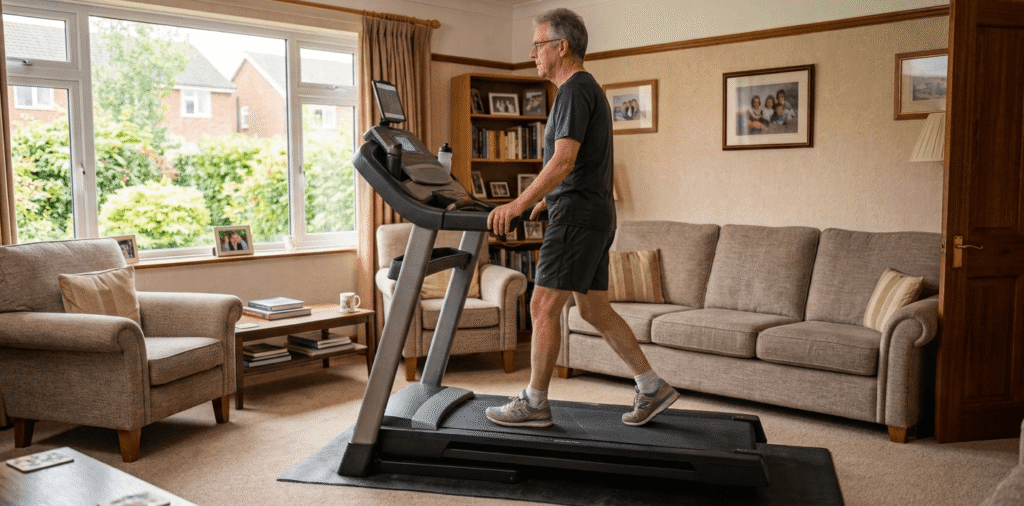
Will it be just you or multiple people using it? If multiple users are using it, make sure the machine accommodates everyone’s body profiles and training requirements. Multiple users usually equates to more hours of usage each week meaning you need a machine robust enough to cope, even if everyone’s using it for jogging or light running. This information will dictate the motor size and machine weight we need.
What weight is the heaviest user? Always an awkward one to ask customers, but it is important to make sure the heaviest user is below the max user weight of the machine. I also wouldn’t go for a machine where you’re just on the cusp either, e.g. you’re 127kg and the max user weight is 130kg. I’d allow at least 10%. This is all just to make sure you get a machine suited to you that will last the distance. And don’t go shedding clothes to fall below the max user weight either, I read a review once from a guy who ran nude on his treadmill. To this day, I’m still not sure whether he was joking or not…
What height is the tallest user? To be honest the more accurate question would be ‘what is their stride length’ as we are all different proportions. However, height is usually the figure people know off the top of their head and is often a good indicator. This will give you an idea of the running belt size you need – this is the actual area you’re running on and is not the same as the assembled machine dimensions, which is the footprint of the whole machine.
What are you actually going to be doing on it?
Walking to hit a daily step count is a very different job to marathon training, and treadmills are built with those differences in mind. Have a think about:
What speeds will the machine be continuously used at and for how many hours a week? Base the speed off the user who will be giving it the most welly.Factor in the accumulated hours spent across all users. This will feed into specs like the motor type and size required. Also when running at high speeds the body sways a lot more, so check out the running area dimensions too.
Do you want to replicate hill climbs? If so you’ll need a machine with incline which is actually a standard feature with most treadmills these days apart from some low end models or walking pads (although even some of these come with incline now.) If you want to practice tackling really hilly terrain you get on hikes, look for a machine called an Incline Treadmill which can go up to 60% incline.
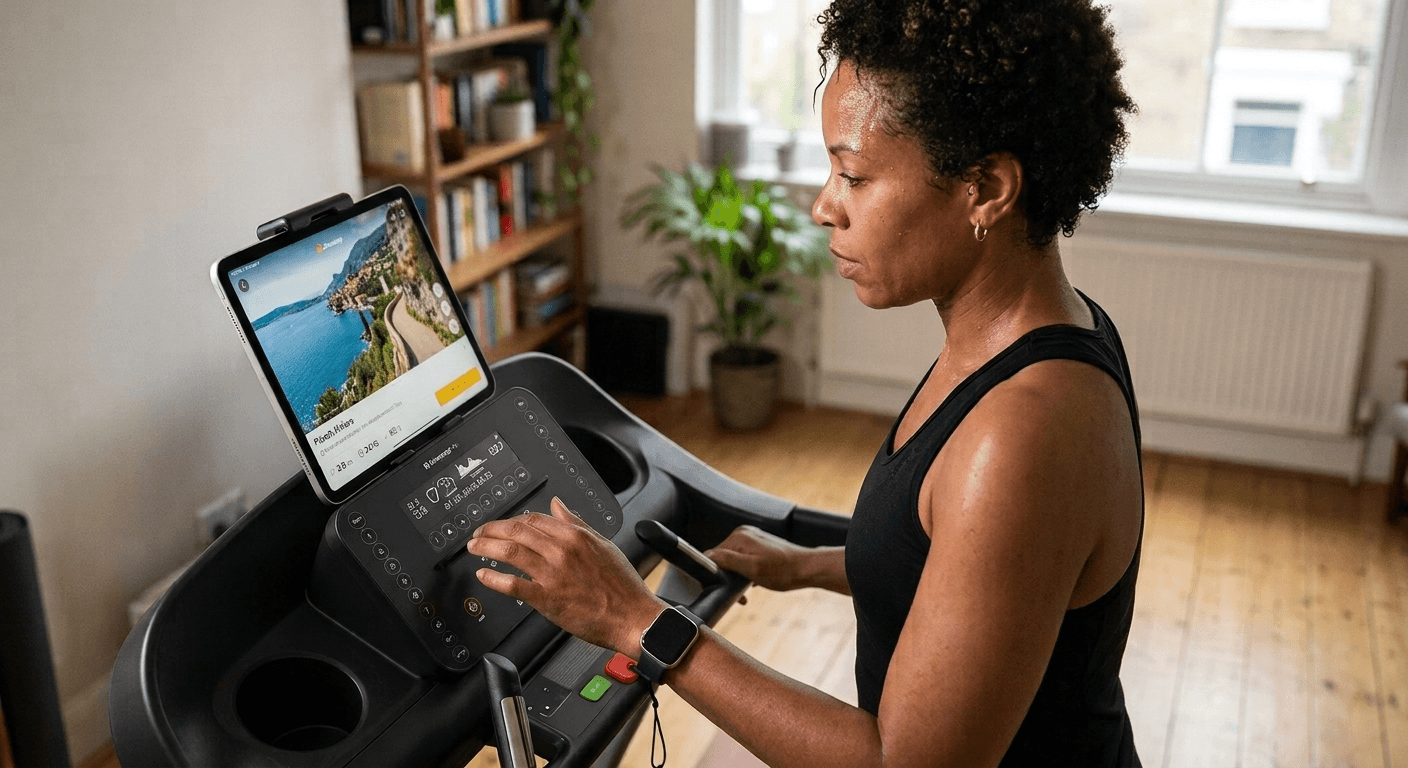
Do you want to do interactive workouts? For this you’ll need a smart/Bluetooth treadmill, which many are these days. However, if you have a particular app you plan to use make sure it’s compatible. Some treadmills come with their own built-in interactive training platform which can be very restrictive when it comes to using any third party apps like Zwift or Kinomap.
💡Tip: Don’t assume that the machine’s max speed is designed to be run at continuously for hours on end. If you’re an experienced runner who regularly runs 10k at 16 kph average speed and go for a machine with 16 kph max speed but a low spec motor e.g. let’s say 2 CHP, it’s likely to not stand the test of time. That 16 kph max speed is really there just for interval training or short distances.
How much space have you got?
It’s easy to fall in love with a treadmill online and forget to check if you’ve actually got enough room for it. Ask yourself:
How much floor space can you spare? Both for the treadmill itself and the clearance around it. Allow over 50cm each side. I’d actually leave at least a meter behind the machine in case the worst happens! Look at the treadmill’s assembled dimensions to see if it fits within your planned area.
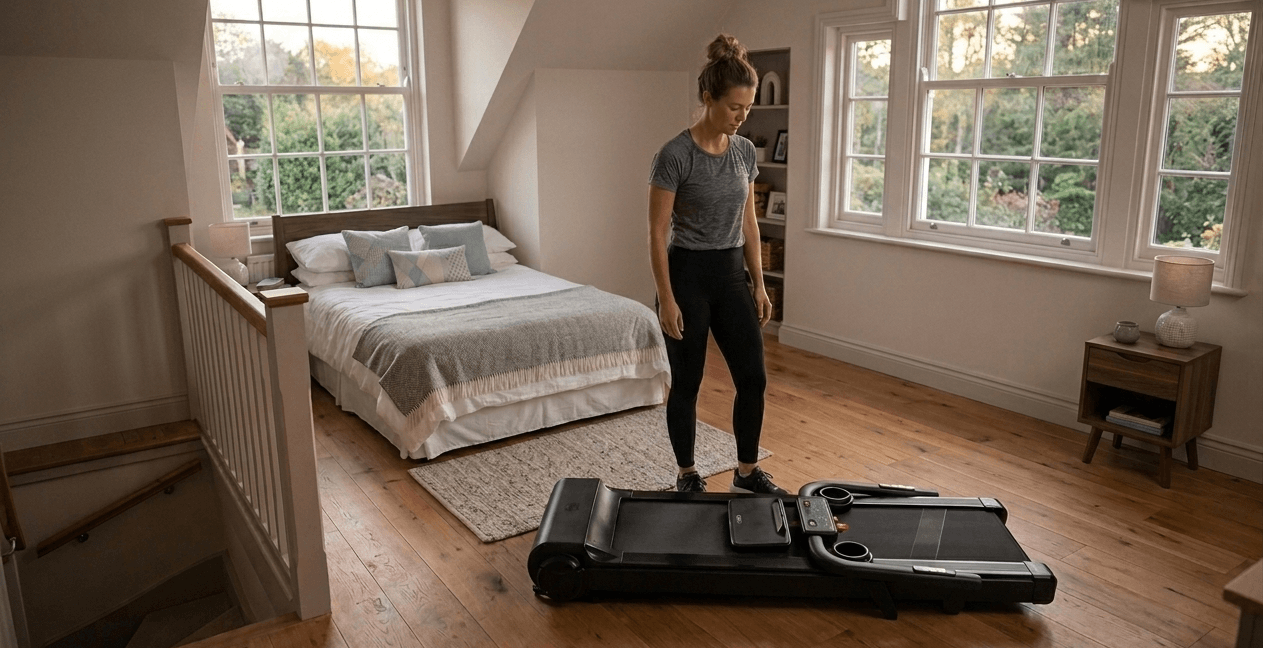
Do you need to fold it away after workouts? If you want it completely out the way, flat folding treadmills are great because they are collapsible and can be stored on their end or flat under furniture – but check the folded machine height to make sure it fits under your bed or sofa first. If you just want to save on some floor space a fold up deck is ideal – the deck folds up at an angle rather than completely flat and reduces the machine’s footprint. This is actually the most common frame type for many models.
Is the ceiling height enough? Check the floor-to-deck height of the machine both flat but crucially when at full incline. Then add the height of your tallest user to it. Subtract that total from your ceiling height to make sure there’s enough headroom.
What to look for in a treadmill – key specs
With the usage questions out of the way, you’re ready to start comparing the numbers on the spec sheet. Here’s what actually matters and why.
What motor size do I need?
Power (CHP)
Working out the motor power you need (Continuous Horsepower, or CHP) comes down to a mix of factors, including user weight, frequency of use and activity level. This is why we asked about these earlier. I’ve put together the following table to help give a rough indication of the minimum motor power you should be looking for based on your intended usage.
The aim is to point you in the right direction rather than provide set-in-stone rules. Use this guide alongside the treadmill’s overall specification and the manufacturer’s stated suitability for your intended use.
Step
Usage
Recommended CHP
1. Choose your activity level Based on a user up to 90 kg (approx. 14 st) and up to 45 mins daily use
Example: A 100 kg user (approx 16 st) running at 12 kph (7.5 mph) for 30 minutes per day would need at least 3 CHP: 2.5 CHP base + 0.5 CHP for body weight. No additional daily-use adjustment is needed because the base figure already allows for up to 45 minutes per day.
Note: For multiple users, base the calculation on the heaviest or most demanding user and use the combined total daily usage time. Some flexibility will be needed where usage varies significantly between users. For example, two users under 90 kg may each jog for 30 minutes a day, while a third user over 90 kg only does one hour of fast running per week. In cases like this, consider both the total usage and how demanding each user’s workouts are rather than applying the formula too rigidly.
💡 Tip: Look out for the motor listed as CHP, or Continuous Horsepower. This tells you how the motor performs under sustained use, rather than in a short burst, so it’s a far better guide than peak horsepower figures. That’s why you may see some dirt cheap treadmills out there advertising a 3 HP motor – they are listing peak not continuous. Tut tut tut.
Brushless vs Brushed & AC vs DC
Motor size isn’t the be-all and end-all. Brushless motors are generally considered a step up from brushed motors because they have fewer parts that wear out, helping them run quieter, more efficiently and with less maintenance.
You may also come across AC motors, particularly on higher-end or commercial treadmills. These can be a good option for frequent, demanding use, although a well-designed DC motor may be just as suitable for many home users.
What is the treadmill’s maximum user weight?
This ties in a bit with the above. Always check the maximum user weight and, as a bit of insurance, leave some leeway (say 10%) rather than sitting right on the cusp.
A treadmill running right at its limit will wear out faster and won’t feel as smooth underfoot.
How much running area do I need?
This is the actual space you have to move on. A cramped belt will make you shorten your stride or feel like you’re about to fall off, which isn’t much fun at any speed. The size of deck you feel comfortable running on comes down to personal preference but here are some ballpark figures to keep in mind:
To give you an idea, I’m 5ft 8 who regularly runs at no less than 12 kph (excluding warm ups) and I wouldn’t want to go less than a 140 cm belt length. That said, I clocked a few miles at 16 kph when testing a 122 x 45 cm belt before and felt okay, but I wouldn’t recommend it.
User profile
Type of usage
Recommended running area length
Minimum running area width
Less than 6 foot
Running & Jogging
140 cm (55 inches)
50 cm (20 inches)
6 foot or over
Running & Jogging
150 cm (59 inches)
50 cm (20 inches)
Most heights*
Walking only (Up to 6 kph / 4 mph)
120 cm (47.2 inches)
40 cm (15.7 inches)
* If you are well over 6 foot, I would double check if 120 cm is enough, even if you will only be walking. Try either testing out the machine before purchasing, or get the tape measure out and draw out an outline to give you a better idea of how much room you’d have when moving. If it feels too small, this will rule out a lot of walking pad options where 120 cm is a common length.
💡 Tip: Don’t confuse running area with the machine dimensions. Running area (or running belt size) is the space you’ll have to run on. Machine dimensions (or footprint) is how much space the WHOLE machine will take up. The latter is the figure you’ll use to see if the treadmill fits in your room.
How do I find out my stride length?
Although we’ve been using height as a guide for working out how much running area you might need, stride length is actually the more important measurement.
Your stride length also changes depending on how fast you’re moving. It will generally be shorter when walking, longer when jogging and longer again when running at faster speeds or sprinting. This means the amount of running belt you need will depend partly on how you plan to use the treadmill.
If you use a fitness tracker or smartwatch, you may already be able to find your stride length from a past outdoor run. For example, the Garmin Connect app shows your stride length for activities recorded as a ‘Run’.
It can be useful to check your stride length at a pace similar to how you expect to use the treadmill. If you mainly walk, record a brisk walk, but if you have a Garmin device, record it as a ‘Run’ activity rather than a ‘Walk’. If you plan to run, check your stride length during a run at your usual pace, as well as during a full sprint. Record these separately to avoid skewing the data. This should give you a more useful indication of the running area you need.
Do I need incline?
Adding incline can make a workout harder without ramping up the speed so is a bit friendlier on your joints. You’ll be working additional muscles too. Many treadmills come with a digital incline of 10-15%.
💡Tip: Digital incline is standard for the majority of treadmills. This is where incline is adjusted by the pressing of buttons. However, some very cheap treadmills may feature manual incline, which involves stepping off the machine and adjusting the incline of the deck – far less practical.
If you want to replicate the tough hill climbs you’d get on a mountainous or coastal hike there are ‘Incline Treadmills’ where the incline can go up to 60% – so steep you may need abseiling gear! Max speed at these extreme inclines usually goes up to 6 kph.
Some models throw in a decline setting too, usually only 1-3%, to replicate downhill terrain you’d get outdoors. Personally, I don’t feel a whole world of difference when running at such a small % decline so I wouldn’t make a special point of seeking this out.
💡Tip: Don’t get confused between ‘incline %’ and ‘incline levels’. Levels is the number of increments that the incline goes up in. So 15 levels doesn’t mean the machine inclines up to 15% – it basically means you’d press the ‘up’ button 15 times to get to full incline, whether that’s 10%, 12% or 15% etc.
Cushioning and shock absorption
A treadmill with good cushioning will be noticeably kinder on your knees and hips than running on pavement. However, navigating through the different cushioning or suspension types can be tricky – many have their own trademarked snazzy sounding system all promoting the same – that it reduces impact by such and such percent with nothing actually backing it up.
However, in the technical specification many often provide the number of cushions as an indicator e.g. 8-point cushioning. The higher that figure within a manufacturer’s range, the more cushioning. Some machines even allow you to turn off the cushioning so you get the same impact as if running on the road.
What frame types are available – folding, fixed, handle-less
We’ve already touched slightly on this but these are the main frame types:
Fold-up deck(commonly referred to as just ‘folding treadmills’) – the most common type out there, where the deck folds up at an angle and then lowers using a hydraulic assist system to ensure it doesn’t clatter against your lovely floor.
Flat folding – the machine is completely collapsible and can be laid flat or stored upright. Depending on the machine’s folded height, you may be able to store it under furniture. Another benefit is that these machines require little to no assembly.
Fixed frame (non-folding) – most common on commercial grade machines designed for heavy usage. If the folding feature is important for you but you know you’re going to put your treadmill through its paces, look out for machines described as ‘folding semi-commercial’ or ‘light-commercial’.
Handle-less – this applies mainly to walking pads which typically don’t feature any upper frame or handles to hold on to. You’ll also find this a lot on another type of treadmill we haven’t discussed yet – manual treadmills (or curved treadmills.) Like the one on the Usain Bolt ad! I’ll look at creating a separate guide on this type of treadmill.
💡 Tip: Having the benefit of a folding frame does mean sacrificing a bit in terms of sturdiness and suspension that you’d get with a fixed frame machine, but it won’t be blatantly obvious. In fact, some of the semi-commercial folding treadmills offer a running experience very close to that of a non-folding machine.
Machine weight is a useful indicator of build qualityand robustness. Heavier treadmills often use more substantial frames and components, which can help them feel more stable during use, especially fast runs.
Treadmills aren’t light. If you plan to move the treadmill regularly, check the total machine weight. Even with transport wheels, you’ll need to be comfortable lifting one end of the machine to get it on the wheels.
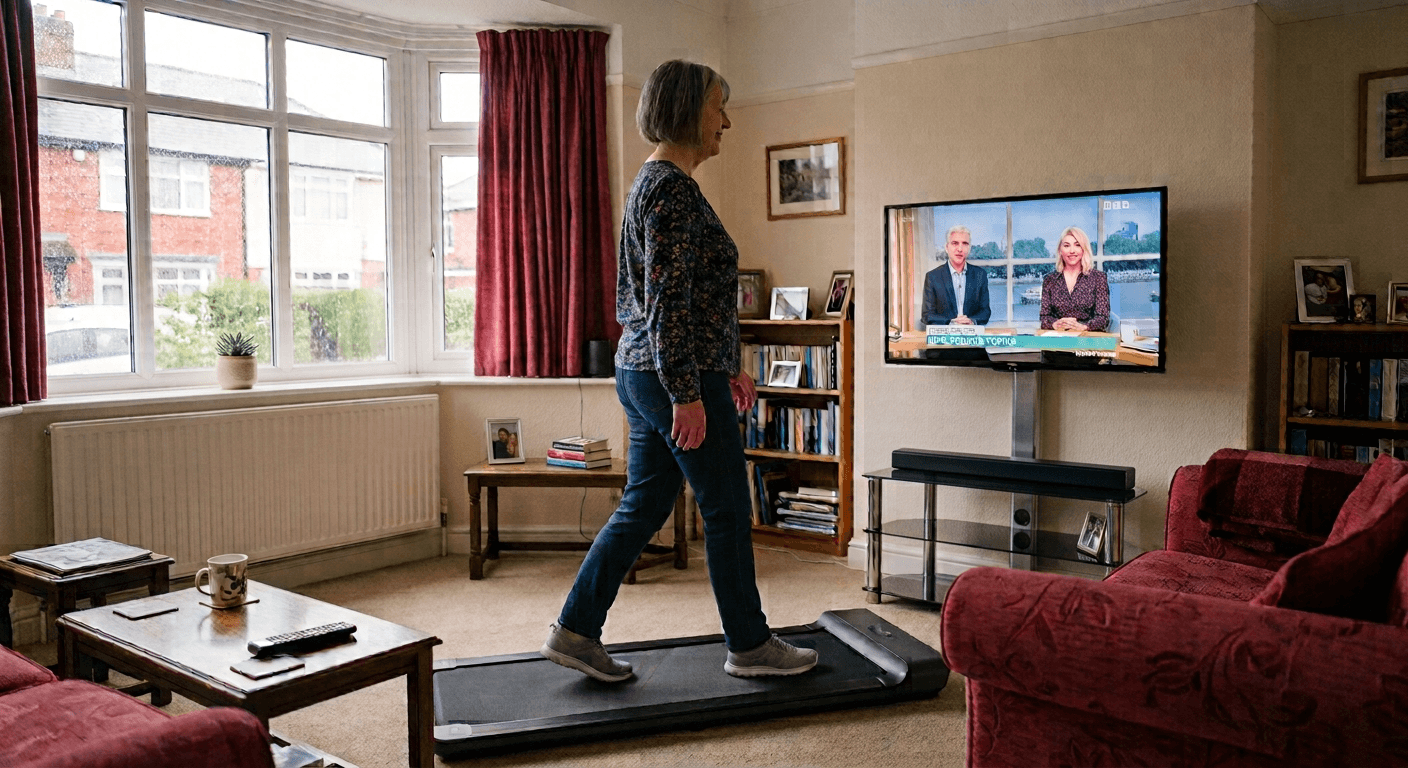
Although walking pads are much lighter than full-size treadmills, they still aren’t light – many weigh between 20-30 kg. So don’t envisage slinging it under your arm and taking it on the bus with you!
Interactive features to consider
Now the core specs are sorted, let’s look at some of the interactive features available. If you’re not fussed about the techy stuff you can skip this bit but you will find most treadmills are smart/connected these days. Hell, you may have no interest in apps now but after a few runs staring at a wall it may become more appealing.
App connectivity
Some smart treadmills come with a subscription to their own training app, often free for a while before it switches to a paid membership. So, check exactly how long that period lasts and how much it costs afterwards – some can be pricey at over £40 per month.
Find out how dependent the machine is on an app subscription – I’ve tried out treadmills where it appears the key selling point is all the interactive workouts it comes with on this nice snazzy screen. But you then discover nearly all that disappears once your subscription is up, leaving you with a few basic built-in programs.
Others are built to connect with third-party platforms like Zwift or Kinomap, which typically offer a limited free tier alongside a paid subscription for the full library of routes and classes. Worth checking before you buy whether the console works with the specific app you actually want to use. Also, check if the app automatically adjusts speed and incline, or if you have to do this manually when prompted.
💡 Tip: Give Customer Service a call if your app’s not listed on the website as they might know from speaking to other customers which work and which don’t.
Can range from the size of an average tablet (10″) up to a small TV screen (24″+).
Often come with a brand’s own training and entertainment platform built-in. Check whether you’re locked in to any plan.
A tilting screen allows you to adjust the viewing angle so you’re not straining your neck.
Pivoting screens can rotate up to 360°, which is ideal for cross-training workouts on platforms such as Peloton and iFIT, where you may move off the treadmill for free weights, floor exercises or workouts on other equipment.
Some models support casting, which lets you display content from your phone or tablet on the treadmill screen.
Some may say that a touchscreen is just another thing to go wrong! So check the warranty – some models come with a dedicated screen/tablet warranty.
LED console with buttons
LED consoles display key data such as distance, time and speed, with physical buttons for adjusting the settings.
These can range in size with the larger consoles being over 20″. However, be sure to distinguish between the console size and screen size e.g. the actual area where your data is displayed may not be the full 20″ advertised.
Some treadmills feature additional buttons on the handles for easily adjusting speed and incline – handy if you’re not comfortable reaching over to the screen to adjust the settings.
If you plan to use your own phone or tablet, check for a ledge or device holder that keeps it clearly visible.
💡 Tip: One thing you may find when using a device holder or ledge is it might vibrate quite a bit. This could be distracting when following a workout on your phone or tablet.
Heart rate connectivity
Wearables
Wearables, such as a Polar chest strap or Garmin watch, will give you a continuous reading and are generally far more accurate. But make sure to double check the machine is compatible with your device first. If it’s not listed on the website, give Customer Service a call – they might not be able to advertise compatibility on the website but may well have spoken to other customers who have tried using a particular brand of wearable on their machines. If not but you’re really in luck, they might have someone in the office with the same or similar device who can trot down into the showroom and try it themselves.
Pulse Sensors
Many treadmills include built-in pulse sensors on the handlebars, but these only give you a reading when you’re actively gripping them, which is a bit of a pain. They are also not going to be anywhere as accurate as a watch, chest strap or other wearable.
What is Heart Rate Training? Heart Rate Training is a type of workout where you aim to reach and remain in a certain heart rate zone. There are five zones and each is based off a % of your max heart rate (MHR). Therefore bpm is your target as opposed to speed or distance. Some machines have built-in programmes which will automatically adjust the speed to keep you in the required zones.
How much do treadmills cost?
You might be asking why it has taken me this long to get to budgets? Well, it’s kind of on purpose – even though many people might make budget the starting point of their search. There’s nothing wrong with that but I think the most important thing is getting a treadmill that fulfils your fitness and lifestyle needs.
You could buy an under-specced machine but then you might not be able to do the type of workouts you want (if not now, in the future when you need more of a challenge) or you’ll be putting too much pressure on the treadmill, reducing its lifespan and leading to future breakdowns which then stop your development and causes frustration.
I could create some typical price brackets for the different types of treadmill but it isn’t so clear-cut. However, I can provide some tips when shopping around:
There’s almost always a sale or promotion going on somewhere! Many brands and retailers hold sales and promotions all year round, whether it be across the whole product range or on particular models. Also look out for welcome offers and email subscription discounts (usually 5-10% off).
Take the RRP with a pinch of salt – Sometimes you’ll see a treadmill’s RRP slashed by a massive amount making it look like you’ve got a deal you can’t refuse. However, it may turn out that it has hardly ever been at its full RRP. Try Wayback Machine to find past snapshots of a product page and check historic prices.
Consider refurbished treadmills – I admit that I’ve always been sceptical about refurbs but having now seen that many are returns where a customer has simply changed their mind, I am more refurb positive! Plus they usually get a good quality inspection before being resold, and often come with the same warranty as they would new. You have to expect a few scuffs and cosmetic damage here and there but you’ll be saving quite a lot.
Be cautious if buying second-hand – Another way of saving money on a model, which could be out of reach if bought brand new. However, it is more risky. Unless the seller is nearby, chances are you’ll have to rely purely on photos to judge the condition of the machine. One important question for the seller is “Is it still under warranty?” If it is, contact the fitness equipment brand to check whether warranties are carried over from user to user. Some don’t allow this.
Where can I buy a treadmill?
Specialist fitness equipment retailers
Incl. Fitshop, Fitness Superstore, Sweatband
Sell a wide range of machines from many different brands.
Fitshop and Fitness Superstore have shops/showrooms across the UK while Sweatband has a showroom in Milton Keynes where you can try out machines. Just ring them up beforehand to double-check the treadmill you want is there.
Some brands such as JTX and JLL only sell direct to customers which cuts out any middlemen. Some may have an Amazon store but the machine will still be sold and shipped by them.
Smaller brands will likely have just one UK showroom. For example, JLL Fitness has a centrally located showroom in Birmingham.
Don’t assume you can walk away on the day with a treadmill if you see one you want. Although you may be at their HQ, their machines are most likely stored at a courier’s depot elsewhere in the country.
General Retailers
Incl. Argos, John Lewis
Large fitness equipment will usually be unavailable to collect from the store and will be home delivery only.
No showrooms or shops where you can try machines out beforehand.
💡Tip: Some well-known retailers will use their website as a marketplace to advertise products being sold by other sellers. These include Decathlon, Currys, B&Q, The Range and quite a few more, so just be aware of this – you won’t see an aisle for treadmills next time you go shopping for kitchen tiles at B&Q!
What other things should I consider?
Warranty and Return Policies
You don’t like to think there’ll be issues with your new treadmill, but a warranty is there to give you peace of mind. For treadmills, it’s usually split into:
Repair warranty – this is the one that is commonly advertised, and covers labour and parts for any issues you have. These often range from 1–3 years.
Motor and frame warranty – both of these are usually covered for many years, if not lifetime warranties.
💡 Tip:A lot of machines will come with something like a 28-day return policy in case you change your mind, but make sure to check the terms and conditions, as you’ll most likely need to pay for delivery to return it, which isn’t cheap.
Delivery and Assembly
Sounds silly, but you or someone else will need to be home to take delivery, in case you need to plan this around work. Often the courier company will be in touch to agree a date after you’ve placed your order.
Machines with a boxed weight of 80kg or more will only be delivered to ground floor rooms. If you need it upstairs, find yourself two strong friends, or hire someone to do it, like a moving company.
Check the machine’s ‘boxed dimensions’ to make sure it fits through any doorways or lifts.
If you’ve ordered accessories with your machine, chances are these will turn up as a separate delivery, so don’t panic if your mat arrives the next day and you think they’ve forgotten your treadmill! Or vice-versa.
Brand new machines will come boxed, but if you’re buying a refurbished machine it may turn up pre-assembled on a pallet and be doorstep delivery only. So again, have a think about logistics if this is the case, and check with the supplier on what to do with the pallet afterwards.
Treadmills are usually relatively simple to assemble – if you properly read the instruction manual! It might be doable by one person but having a spare set of hands will definitely make life easier, especially for larger, heavier models. If you’re not feeling confident you can buy an assembly service for the machine. On the other hand if you’ve got a flat folding machine most of these are ready assembled. Just unbox, pop it up and you’re good to go.
If you’ve ordered assembly with your machine, chances are it won’t be carried out on the day of delivery unless explicitly stated. It’s usually up to 7 working days after.
💡 Tip:Be cautious when ordering through the likes of Amazon. When buying direct from a fitness equipment supplier or retailer, a specialist engineer will often assemble your machine; Amazon, on the other hand, tend to advertise their own assembly service as a cross-sell, which can be appealing as it’s much cheaper, but will most likely be carried out by a handyman or furniture assembly service who have no experience of treadmill assembly. This could lead to future issues and invalidate your warranty if it’s not put together properly.
Maintenance
I know it’s a pain, but again please always read the instruction manual. It can save you a lot of grief, both when assembling (not cutting any straps prematurely) and when it comes to looking after your machine to keep it running smoothly for as long as possible.
One of the simplest maintenance jobs is just to give the machine a wipe down each time it’s used, as that sweat has to go somewhere. Over time this can build up, and although your machine may look fine on the outside, it could be causing some grim scenes within it.
Another common maintenance task is lubrication. This will be less frequent – check the manual to see how often this needs doing, as a handful of machines might not even need it. Many treadmill issues stem from either under or even over-lubrication. You don’t want a belt dripping in lube!
Company reputation and reviews
The fact you’re on this website is a sign that you’ve started doing your detective work but when choosing between brands just check out their reviews in places like Trustpilot, Feefo, Google and Amazon. You’ll gain a quick idea of whether they are any good. Also there will be none out there which get all perfect reviews – and I’d be suspicious if they did! You’ll always get some 1 star reviews even if the majority are 5. Sometimes there is a truly valid reason but sometimes it’s just someone being difficult.
Keep in mind some negative reviews may be about how a product is delivered…or not in some cases! Fitness equipment companies often use a third party courier to deliver machines and unfortunately how and when a product turns up is out of their hands. But what you can judge them on is how they deal with the situation in terms of trying to fix the issue by liaising with the customer and courier company. A 1 star review can turn into 5 based on the way the company handles the problem.
If you see a deal which looks too good to be true, it most likely is! Whether you’ve seen a 4HP commercial grade treadmill for £150 on a marketplace or you’ve found a website selling your desired model for 50% less than all the other retailers out there – especially if the checkout is all done through their own website! So search the company on TrustPilot for their star rating – if it’s low or there are no or little reviews this raises alarm bells. However, don’t get confused between scammy websites and affiliate websites who promote products on their website and then direct you to the genuine seller – this is perfectly common and fine.
FAQ
Are treadmills quiet?
No. Next question. The reality is that it’s near impossible to use a treadmill quietly, as even if the motor is quiet, you’re still going to be pounding away on the deck. If sound is a crucial factor, say you’re in a block of flats where you can hear a pin drop, or you want to use it in the other room while the kids are asleep, a treadmill may not be the best option. A cross trainer may be the next best thing, and the closest to a running motion, yet is very quiet.
Is it worth having a fan on a treadmill?
Now, I read a post on Reddit once where someone literally picked one treadmill over another because one had a fan and the other didn’t. Although you may have visions of a gale-force breeze blowing back your curly locks as you’re hammering away on the machine, the truth is this is unlikely. In my experience with built-in treadmill fans, it’s more the equivalent of someone lightly breathing on you. Some recent machines now promote fans that adjust in power based on the intensity of your run, but I still remain skeptical. To summarise, I wouldn’t make a built-in fan a dealbreaker. Just get yourself a good stand-alone fan for the room.
Do I need a treadmill mat?
Not always, but I’d recommend one. On hard floors, I’d definitely use a mat to help prevent scratches, dents and other damage. They’re also well worth having if you’re in a block of flats or using the treadmill upstairs, as they can help reduce vibration and noise travelling through the floor. On carpet, a mat also helps keep fibres and dust away from the underside of the machine.
Can I put a treadmill upstairs?
Yes, but check the machine weight and how you’re actually getting it up there first. If the boxed weight is 80kg or more, couriers will generally refuse to carry it upstairs, so you’ll need a couple of strong friends or may have to hire someone such as a removals company. Also check the boxed dimensions against your stairs, doorways and landings before ordering – discovering it doesn’t fit halfway up isn’t a workout I’d recommend.
Can I keep a treadmill in a garage?
Sometimes, but check the manufacturer’s instructions and warranty conditions first. A dry, insulated garage can be fine, whereas a damp, freezing or dusty one is a definite no-no. Treadmills contain electronics and moving parts that don’t particularly enjoy condensation, extreme temperatures or dirt, so keep the area clean and dry and don’t assume garage use is covered by the warranty.
What is a treadmill safety key?
It’s basically the treadmill’s emergency stop. On most motorised treadmills the machine won’t start without the safety key attached (it will beep at you with an error message displayed), and the other end clips onto your clothing. If you stumble or move too far back, it pulls the key away and stops the belt. It might be tempting to leave the clip dangling there, but it’s a safety feature that’s actually worth using. I’ve had the pleasure of testing out the emergency stop accidentally a couple of times at 16 kph, and it does what it says on the tin and quite well – I wasn’t thrown off nor did it muck up my knees. Fingers crossed, you won’t ever need it!
Are treadmill speed and distance readings accurate?
Generally they’re good enough for everyday training, particularly on a properly calibrated machine, but I wouldn’t treat the figures as laboratory-grade measurements! You may find the treadmill figures differ to what you’re seeing on your watch – but your watch has a lot more data to work with, like your user profile and past workout stats. The treadmill’s distance figure is usually calculated from belt speed and workout time, so calibration, belt wear and other factors can create small differences. For most of us, consistency matters more – if you’re comparing runs on the same treadmill, you’ve still got a very useful benchmark.
Author: Ian Smith For the past five years I’ve worked in marketing for one of the UK’s leading fitness equipment brands. During this time I’ve learnt a thing or two about fitness equipment: what’s out there and commonly asked customer questions. I also regularly used the equipment myself and would help test out new products. LinkedIn profile